
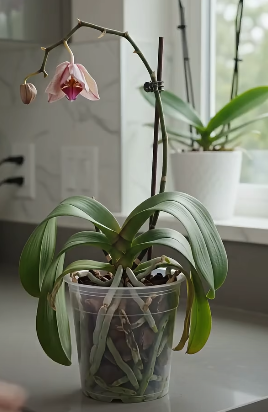
A wilted, droopy orchid can look like a lost cause. The leaves sag, the flower spike bends, and the whole plant seems to be giving up. Before it goes in the trash, it’s worth slowing down for a minute.
Wilting is a symptom, not a diagnosis. Orchids wilt for a handful of very different reasons, and the fix for one cause can actually make another cause worse. Water a dehydrated orchid and it perks back up. Water an orchid that’s wilting from rotted roots, and you can finish it off completely.
Before you decide an orchid is beyond saving, check these three things first.
1. Check the Roots, Not Just the Leaves
Wilted leaves are the plant’s way of telling you something is wrong below the surface. The roots are where the real answer is.
Gently slide the orchid out of its pot, or if it’s in a clear plastic pot, simply look through the sides.
Healthy orchid roots are firm to the touch and typically appear green (when moist) or silvery-white (when dry). They should feel solid, almost springy, when you press them gently.
Rotted roots feel mushy, hollow, or flattened. If you squeeze one gently and the outer layer slides off like a wet noodle, leaving a thin wiry strand behind, that root is dead. Rotted roots are usually brown or black and often have an unpleasant, slightly sour smell.
Dehydrated roots look shriveled and papery but are still firm, not mushy. They haven’t rotted, they’ve simply been dry for too long.
This single check changes everything about how you move forward:
– If most roots are firm and green or white, the plant likely needs more consistent watering.
– If several roots are mushy or hollow, you’re dealing with root rot, and the fix is completely different: less water, more air, and possibly a repot.
– If the roots are shriveled but intact, the orchid is thirsty, not dying.
Never judge an orchid by its leaves alone. A plant can have gorgeous green leaves while its root system is quietly rotting away underneath, and by the time the leaves show it, the damage is already advanced.
2. Check the Base of the Plant and the Crown
The next place to look is where the leaves meet the base of the plant, an area orchid growers call the crown.
For a Phalaenopsis orchid (the most common orchid sold in stores), the crown is the small central point between the lowest leaves, where new leaves emerge. This spot is the plant’s growing point, and it’s also its most vulnerable one.
Gently press the base of the lowest leaves and look closely at the crown.
– Firm and green: a good sign. The plant’s growth center is intact, even if the rest of the plant looks stressed.
– Soft, yellow, brown, or mushy: this points to crown rot, often caused by water sitting in the crown for too long. This is more serious and needs to be addressed quickly, or it can kill the entire plant.
– Leaves that pull away easily from the stem with little resistance: another sign of rot working its way through the base.
If the crown itself is soft or mushy, that’s a more urgent situation than simply wilted leaves. A plant can lose a leaf and survive. A plant that loses its crown to rot often cannot recover, at least not from that growing point.
If you catch crown rot early, some growers have success by carefully drying out the affected area, removing any visibly rotted tissue with a clean, sterilized blade, and keeping water away from that spot going forward until it fully dries and calluses over.
3. Check How Long the Wilting Has Actually Been Happening
The third thing to check isn’t on the plant at all. It’s your own memory.
How long has this orchid actually looked wilted?
A plant that’s been slightly droopy for two or three days, especially after being underwatered or exposed to heat, is often perfectly capable of bouncing back with a good, thorough watering.
A plant that’s been progressively wilting for weeks, with leaves that are also turning yellow, dropping, or wrinkling one after another, is telling a different story. That pattern usually points to an ongoing problem, most often with the roots, rather than a single dry spell.
Timeline matters because it tells you whether you’re looking at an emergency or a slow decline:
– Sudden wilting after a missed watering or a hot day: usually reversible, often within a week of proper care.
– Gradual wilting over several weeks, leaf by leaf: points to a root or crown problem that needs to be physically addressed, not just watered through.
– Wilting that started right after repotting: the roots may be adjusting, or they may have been damaged during the process. Give it time, but keep watering conservative.
Being honest about the timeline helps you avoid two common mistakes: giving up on a plant that just needs one good drink of water, or continuing to water a plant whose real problem is rotted roots that need less moisture, not more.